Navigating Dating After the Loss of a Partner

February 6, 2026

Losing a spouse or partner is an experience that can reshape every aspect of daily life, including how you connect with others. As you navigate the journey of grief and healing, you may find yourself wondering if—and when—dating might feel right for you. 

Consider the following questions:

Where are you in your grieving process?

  • Many people the year following the loss of a spouse or partner to be a period of enormous adjustment and wait to begin dating until getting through these “firsts”. But, everyone’s grief is unique, and you may be ready before then, long after the first year, or never.


Who do you want to include in the conversation?

  • You may want to seek input from or to inform your adult children, close friends, or faith leaders as you make your decision.


What do you hope to gain for a new dating relationship?

  • Reducing loneliness or finding a consistent companion may be a key factor. Spend some time in honest reflection about expectations of a new relationship. Ask yourself the hard question “Am I trying to replace the roles my partner filled in my life?”.


Have you considered the full range of ways to address loneliness?

  • Becoming more active in your community, joining a class, deepening existing friendships, adopting a pet, and volunteering may also help.
  • Special note: Please make sure you have the energy and resources to dedicate to caring for a pet before you adopt an animal.


If you choose to begin dating, what are you comfortable telling your dates about your widowed status?

  • Some people share details about this part of their lives right away while others choose to wait until they are more comfortable in their new relationship.


Safety Guidelines to Keep in Mind:

  • Look out for signs of romance scams or people that may take advantage of you.
  • Be cautious about giving out personal details too soon.
  • Be suspicious of any request for money in dating. Avoid sharing any financial information.
  • Do a Google search on the person you are considering dating.
  • Be aware that a date outside of your same age category is higher risk.
  • Meet in a public place for a first date and let a friend/family member know where you are.
  • Arrange a call from a friend during the 1st date—to have a graceful exit, if needed.
  • Limit alcohol on dates—stay in control.
  • Arrange for your own transportation so you can leave when you want.
  • Limit/avoid personal information in your dating profile, if you post online.
  • Remember that sexually transmitted infections can be contracted at any age.
  • Take it slowly. Being cautious and allowing time for a new relationship to grow will give you time to reflect on your experience and reduce the risks of dating.


Our grief care services are for anyone in the community who has experienced the loss of a loved one. Discover how our team can help you and your family by contacting us through our website or calling 855.492.0812.


Other Resources

whatsyourgrief.com/widow-dating-am-i-ready

getgriefymagazine.com/blog/dating-and-remarrying-after-death-the-untold-truth


By Mike Brown, MSW, Lisa King, PsyD, CGD and Melinda Simpson, LCSW, APHSW-C
Bereavement Counselors  |   Bluegrass Care Navigators

The Coleman Family
March 19, 2026
In 2024, the Coleman family’s world was shattered with a devastating cancer diagnosis and unexpected loss of Jessica, devoted wife and mother. Kyle and his three daughters were overwhelmed by grief and the daily reminders of life without her. They connected with Bluegrass Care Navigators’ (BCN) grief team whose compassionate support and counseling helped the family find comfort, connection and the tools to heal together.
Bluegrass Care Navigators Expands Bluegrass Transitional Care Program with Grant Award in Partnershi
March 17, 2026
Expansion will improve access to care and chronic disease management for high-risk patients across Laurel, Jackson, and Whitley Counties
Callie, one of our volunteer therapy dogs
By By Callie, Volunteer Therapy Dog (and very good girl) March 2, 2026
Hi. I'm Callie. Most days, my job is simple: walk into rooms with my human, Mary, wag my tail, and let people know they’re not alone. I’ve been doing this therapy dog work with her for a while now, and I take it very seriously, even if I’m small and fluffy.
Doug and Lois Gates, one of our hospice families.
February 25, 2026
For Lois and Doug Gates, home has always been a place of purpose, faith and shared life. Married for more than 63 years, the couple met as teenagers, built a family through adoption, and spent decades serving others together. Their moments together became even more precious after Lois received a serious diagnosis two years ago. After undergoing surgery, the cancer recurred, and the couple chose to forgo additional treatment and live the best quality of life possible with support from Bluegrass Care Navigators (BCN).
PACE participants at Thanksgiving meal
February 17, 2026
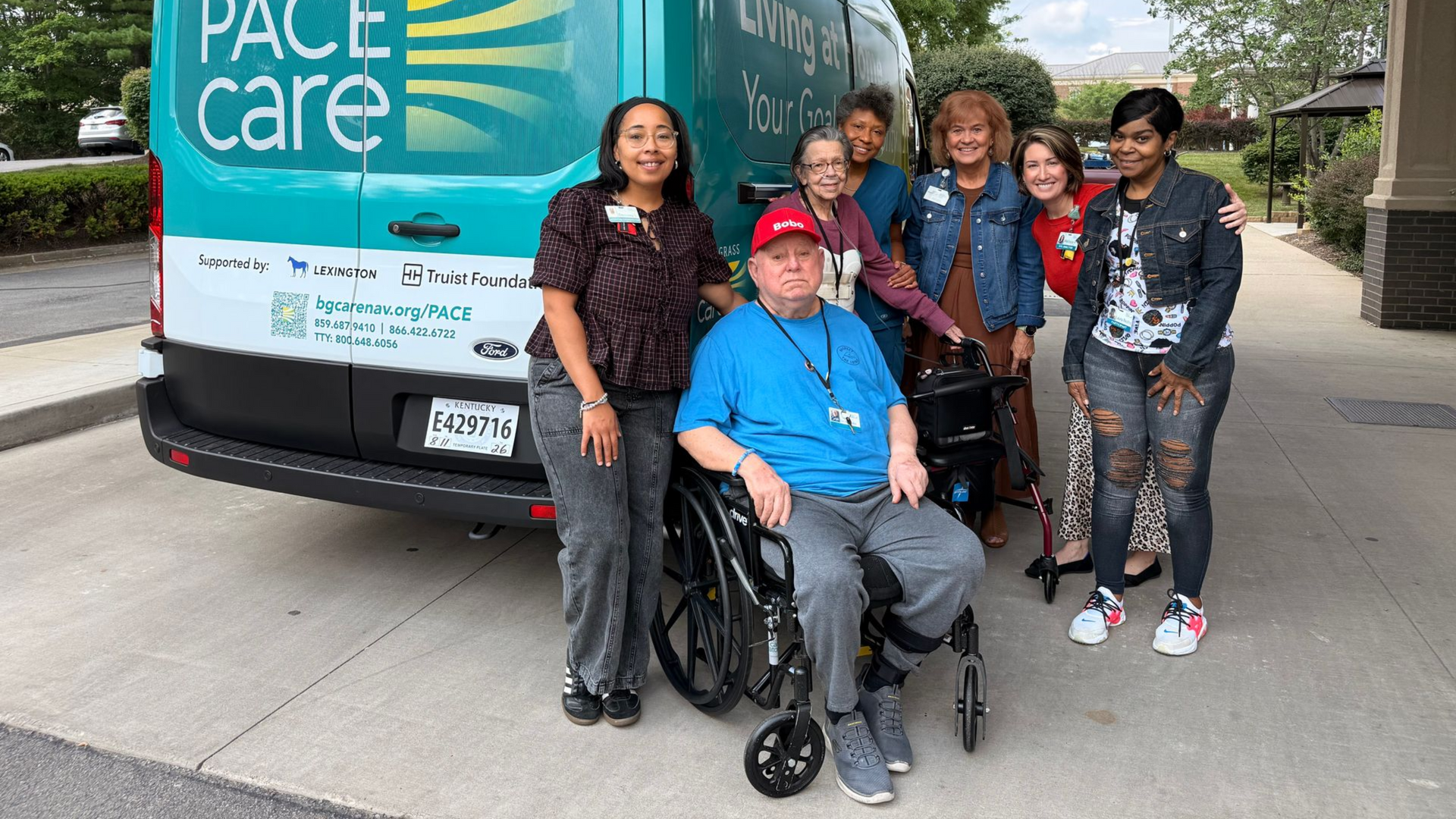
The Bluegrass PACE Care team and participants kicked off the holiday season with their annual Thanksgiving lunch. The atmosphere was filled with gratitude and joy, as everyone enjoyed a delicious meal and each other's company. The PACE team continued to celebrate the holiday season with fun activities in the weeks to come.
Bluegrass Care Navigators provides care in person and via phone
By Lisa Lewis, Support Center RN February 17, 2026
As a Support Center RN, I’ve witnessed many moments of compassion, but few have touched me as deeply as the call I received from a patient’s wife in our Pikeville region. She shared how our nurse, Tiffany Little (RN), provided care with such warmth and dedication that her presence brought genuine comfort and support to their lives.
Tim and Helen Hoffstedder
February 17, 2026
Team BCN brought compassionate, personalized care to Tim and Helen Hoffstedder during a challenging chapter in their lives. After receiving a dementia diagnosis almost seven years ago, Helen’s family did their best to care for her at home. When she required additional support, they moved her to ColdSpring Transitional Care where she could receive high-quality care around the clock. In February 2024, she began retaining fluid and had difficulty breathing. The team at ColdSpring Care referred the family to Bluegrass Hospice Care and that extra support brought her husband Tim immense reassurance.
nurse and patient making a heart
February 17, 2026
Thanks to your remarkable generosity, our two-year Care Reimagined fundraising campaign has been a resounding success. With your steadfast support, Bluegrass Care Navigators exceeded our ambitious $7 million goal by the December 31, 2025, deadline! This achievement ensures that we can continue to provide essential care and support to seriously and terminally ill individuals within our community.
Mother and daughter discussing grief on front porch.
January 7, 2026
Build a memory box Use a cardboard box and decorate all the sides with markers or paint, drawing memories, messages or pictures in memory of your loved one. Place items like mementos of special times or add notes or drawings for your loved one. Have a balloon release ceremony Choose a special time, like your loved one’s birthday or anniversary for the ceremony. Pick a place like a park, beach, field or burial site, to release the balloons. Use helium-filled balloons and have family members write words of remembrance on them. You can talk about how loss and change are a natural part of life, play music or read verses as the balloons are released. Plant a tree or flowers Tending to a growing plant is a symbol of an ongoing relationship and provides many chances to grieve a loss. The life cycle can help you reflect on the memory of your loved one. Read a children's book about grief There are many age-specific children’s books that address grief. Books are a great way to help children open up and begin sharing feelings after a loss. Create memory pages Use fun scrapbooking paper and include Information about your loved one, such as their name, birthday, date of death, favorite food or activities, words to describe them, or things they enjoyed. Phrases like "I remember you when..." or ''I feel closer to you when..." can help provide inspiration. Draw with sidewalk chalk art Decorate your sidewalk or driveway with pictures or words honoring your loved one. Creativity is a great way to help express your feelings and emotions. Make a bracelet Use a variety of beads with different colors, shapes and letters. Pick out beads that represent a special memory or detail about your loved one. Decorate a jar or bottle Apply paint, decoupage or other materials to a jar or a bottle. You can write messages and place them inside the bottle. These messages can be something that you did not get a chance to say, something that you wish you had done or said differently, a favorite memory, or a life update. Alternatively, you may wish to place a small candle or light inside and use it at times you wish to remember your loved one. Utilize a journal You can use a journal to write about or draw special memories of your loved one. Add photos or mementos to make it feel special. Make a playlist Create a list of your loved one’s favorite songs. Listen to this when you want to think about them. Recreate a favorite recipe Prepare a meal or dessert that your loved one enjoyed or made frequently. While you are making it reminisce about memories associated with the food and favorites that you enjoyed together. Our grief care services are for anyone in the community who has experienced the loss of a loved one. Discover how our team can help you and your family by contacting us through our website or calling 855.492.0812 .
Women grieving
January 7, 2026
1. Reflect and remember Relive experiences in your thoughts. Allow the details and the emotions that come with them to be fully expressed. Explore memories as they come up. Trust that your system is bringing up these thoughts as part of your healing process. The repetition of painful memories helps flush out the strong emotions attached to them. 2. Share stories Talking about your loss provides a great deal of release. You may need to tell the same stories over and over as part of your healing. Support groups provide a place where you have the opportunity to be heard and can continue to talk about your grief in a supportive environment. 3. Write it down Keeping a journal is not for everyone, but it can be a powerful tool for healing. Writing about feelings and events can help you to identify emotions. Words help constructively channel these emotions and show a record of your progress. 4. Don’t be afraid to cry Tears can relieve a lot of pressure and tension. Learn to trust your body’s need to cry or not. Individuals grieve differently. Tears are not a sign of weakness and do not mean that your emotions are out of control. 5. Make space for your loss People commonly fall out of their routines after the loss of a loved one. Because of this, they may feel they have too much unstructured time in which to grieve. It is OK to take time to sit with a loss. Other days, you may feel the need to be as busy as possible. Make time to create quite moments to work through your feelings. Respecting your needs for healing and creating opportunities to grieve is important. 6. Take care of yourself Do your best to nourish your body and rest. Get outside and enjoy the fresh air. Exercise can release a surprising amount of tension, anger and frustration. It is important to make self-care a priority. Our grief care services are for anyone in the community who has experienced the loss of a loved one. Discover how our team can help you and your family by contacting us through our website or calling 855.492.0812 .